Is Purgatory Real? – It Might Not Be
 Is Purgatory Real? – It Might Not Be
During one of my “occasional” Bible reading times as a young Christian, I was reading Luke’s account of Jesus’ crucifixion:
“Then he (the thief) said, “Jesus, remember me when you come into your kingdom”. Jesus said to him, “Amen, I say to you, today you will be with me in Paradise.” (Luke 23:42,43 NCB)
My immediate reaction was “Hey, why doesn’t the thief have to go to purgatory?!”
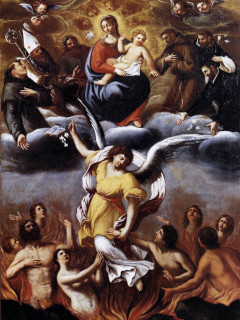
Growing up Catholic meant certain things to me – mass every Sunday, Confession at least once a month, Catechism class during the week, and when you die, your soul goes to purgatory before you can enter Heaven.
Then I started to do some research into the historical development of purgatory. Where did the idea of purgatory come from, and what does the Holy Bible say about it? Here is what I found...
The following passage comes from 2nd Maccabees, a history book authored about 200 years before Christ: “Then he took up a collection from all of his soldiers, amounting to two thousand silver drachmas, and sent it to Jerusalem to provide for an expiatory sacrifice. In doing this, he acted in a suitable and honorable way, guided by his belief in the resurrection. For if he had not expected those who had fallen to rise again, it would have been superfluous and foolish to pray for the dead. However, if he was focusing on the splendid reward reserved for those whose death was marked by godliness, his thought was holy and devout. Therefore, he had this expiatory sacrifice offered for the dead so that they might be delivered from their sin.” (2 Maccabees 12:43-46 NCB)
This passage indicates:
1) A certain prominent Jew believed in the resurrection, that is, the physical rising of the dead to life.
2) Some Jews believed that there was a “time period” between one’s death and resurrection in which a person’s eternal fate could still be re-directed.
3) During that “time period”, the dead, who had not previously lived a holy and devout life, could have their past sins paid for by a donation to the proper religious authority. In so doing, the dead person, who would have otherwise spent eternity in Sheol, would, instead, go to heaven at the time of the resurrection, because of someone else’s monetary “sacrifice."
This idea was further cemented into the early Roman Catholic church by St. Augustine of Hippo (354-430 AD) whose ambiguous writing on this subject in “The Handbook on Faith, Hope, and Love” speculated that “some believers shall pass through a purgatorial fire, and in proportion as they have loved with more or less devotion the goods that perish, be less or more quickly delivered from it.”
By the time of the Dark Ages, the Dutch Catholic theologian, Desiderius Erasmus, famously wrote in his 1509 AD essay, “In Praise of Folly,” his acknowledgment that this was a corrupt practice by the Catholic Church: “What shall I say of such as cry up and maintain the cheat of pardons and indulgences? That by these compute the time of each soul’s residence in purgatory, and assign them a longer or shorter continuance, according as they purchase more or fewer of these paltry pardons, and saleable exemptions?”
Erasmus recognized this teaching on purgatory to be about temporary, financial gain for the Church, not anything representing truth.
Even today, it is common practice in Catholic Churches to sponsor a Mass for a deceased loved one, for the purpose of easing their soul before they get to Heaven.
Now, let’s compare what the New Testament says about this matter:
Hebrews 9:25-28 (NCB): “Nor was it his purpose to offer himself again and again, as the high priest enters into the sanctuary year after year with the blood that is not his own. For then he would have had to suffer over and over again since the creation of the world. But as it is, he has appeared once and for all at the end of the ages to abolish sin by sacrificing himself. And just as human beings are destined to die but once, and after that to face judgment, so Christ, having been offered once to take away the sins of many, will appear a second time, not to deal with sin but to bring salvation to those who are eagerly waiting for him.”
According to this passage: after death, comes divine judgment; it was Christ’s sacrifice that, once and for all, takes away sins; and at the judgment, it will be Christ rewarding salvation to those who were faithful during their lives. Purgatory diminishes what Christ accomplished on the cross for us. In other words, purgatory is saying that Christ’s sacrifice was insufficient to cleanse us from ALL of our sins.
Here’s what Paul the apostle said:
”I am pulled in opposite directions. My desire is to depart and to be with Christ, for that is far better, but it is a more urgent need for you that I remain in the body.” (Philippians 1:23 NCB)
The picture is death and an immediate, joyful fellowship with Jesus. There is no mention of purgatory.
Paul makes this even clearer in his epistle to the Corinthians. He says: “Therefore, we are always confident, even though we realize that as long as we are at home in the body, we are exiles from the Lord, for we walk by faith, not by sight. Yet we are filled with confidence, even as we long to be exiled from the body and be at home with the Lord. For this reason, whether at home or away, we strive to please him.” (2 Corinthians 5:6-9 NCB)
Away from the body is at home with the Lord. That was Paul’s immediate hope! There is no mention of purgatory.
To sum up, the teachings of purgatory came about from one passage in a history book of the Holy Catholic Bible, and was cemented into an established Catholic teaching by various theologians throughout history.
Don’t take my word for it. Do your own research on purgatory. Here are some topics which you might look into:
• What do the Law and Prophets of the Old Testament say about purgatory?
• What does the New Testament say about purgatory?
• How do the teachings on purgatory challenge the well-established Biblical teaching that salvation is possible, wholly, because of Jesus Christ – His life, death, and resurrection?
Here are a few other resource materials you might check out:
• https://www.desiringgod.org/interviews/what-does-the-bible-say-about-purgatory
• https://www.gotquestions.org/purgatory.html
• https://versebyverseministry.org/bible-answers/tweetin_out_of_purgatory
The Bible Says
Is Purgatory Real? – It Might Not Be

Reasons Why Believing in Jesus Can Mean the World to You

How does Christ make a person different?
Who Is Jesus?

Is the Bible Reliable?

Is Jesus God?